
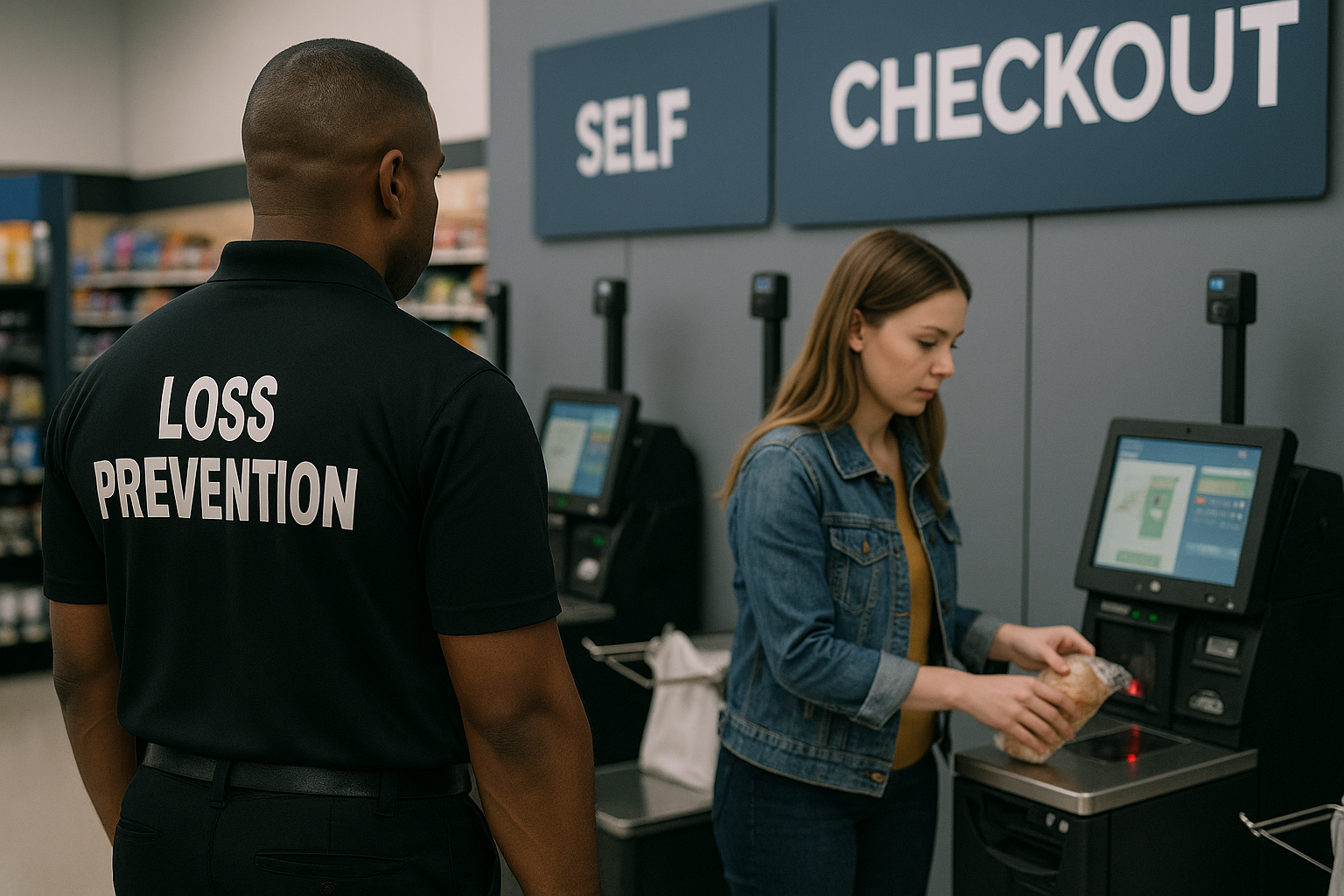
The Complete Guide to Self-Checkout Fraud Prevention in 2025

De Flow AI Team
Self-Checkout Fraud Prevention
The Complete 2025 Guide
Protecting retail revenue with advanced AI solutions
De Flow AI Team
מומחה אבטחת מידע ומניעת הונאות
Executive Summary
Self-checkout fraud is a significant and widely reported source of retail loss, though no single reliable figure covers it across markets and formats. This comprehensive guide covers the latest fraud tactics, detection technologies, and prevention strategies that leading retailers are implementing in 2025 to protect their bottom line.
2025 Self-Checkout Fraud Statistics
Annual Losses
From SCO fraud in 2024
Source: NRF 2025 ReportIncrease in Incidents
Year-over-year growth
Source: Loss Prevention ResearchDetection Rate
With AI-powered systems
Source: Retail Analytics 2025Most Common Self-Checkout Fraud Methods in 2025
The "Banana Trick"
Customers weigh expensive items but select cheap produce codes. Loss per incident depends entirely on the price gap between the item scanned and the item taken.
Prevention: Weight verification algorithms and visual recognition
Skip Scanning
Items passed over scanner without being scanned. Average loss: $8-18 per incident.
Prevention: Motion detection and barcode verification
Barcode Switching
Using fake or switched barcodes for expensive items. Loss per incident is the price gap between the item scanned and the item taken.
Prevention: Computer vision and product matching
Bag Manipulation
Adding items to bags without scanning. Loss per incident equals the full value of whatever left unscanned.
Prevention: Bagging area monitoring and weight sensors
AI-Powered Prevention Technologies
Computer Vision
Real-time product identification and behavior analysis using advanced AI algorithms.
Flags a candidate event for a person to review
Behavioral Analytics
Advanced pattern recognition to identify suspicious customer behaviors and fraud attempts.
Pairs each flag with the till exception from the same second
Real-time Alerts
Instant notifications to staff when suspicious activity is detected at checkout stations.
Routes to staff while the customer is still at the lane
Working Out Your Own Numbers
This section used to hold a table of annual fraud losses, system costs and savings by store size. Every figure in it was invented, including the system prices — and no price for this product is published anywhere, so quoting three of them was doubly wrong. It has been removed rather than re-sourced.
The honest version is a short calculation you can do from your own till data, which is more useful than a benchmark from a store that is not yours:
- Count your self-checkout exceptions for one normal trading month — voids, no-scans, weight mismatches, intervention calls. Your POS already records these.
- Count how many were actually reviewed by a person. This is the number most retailers have never looked at, and it is usually far smaller than the first. If almost none are reviewed, detection is not your constraint — review capacity is.
- Take a sample of, say, fifty and review them properly against the video. Sort them into: genuine customer error, staff process error, and probable loss. The split is the finding; nobody can tell you what it will be.
- Multiply the probable-loss share by your exception volume and by average basket value. That is an estimate with your own numbers behind it, and you can state its assumptions out loud.
Anything a vendor quotes you before step 3 is a guess about your store made by someone who has not seen it. Our shrink calculator handles the inventory-variance side of the same question.
Implementation Roadmap
Assessment & Planning (Week 1-2)
- Audit current self-checkout stations and infrastructure
- Analyze historical shrinkage data and fraud patterns
- Identify high-risk areas and peak fraud times
Technology Installation (Week 3-4)
- Install AI-powered cameras and sensors
- Configure computer vision algorithms
- Set up real-time alert systems
Training & Testing (Week 5-6)
- Train staff on new alert systems and procedures
- Conduct system testing and calibration
- Fine-tune detection algorithms
Go-Live & Optimization (Week 7+)
- Launch full fraud prevention system
- Monitor performance and adjust settings
- Generate monthly reports and analytics
Ready to Stop Self-Checkout Fraud?
See scan-to-bag correlation running on your own self-checkout footage before you commit to anything
What actually gets reported — and what doesn't
Self-checkout losses are easy to underestimate because most retail theft never becomes a police statistic. In the UK, police recorded 509,566 shoplifting offences in the year ending December 2025, while retailers logged 20.4 million theft incidents over a comparable year. The gap is not a rounding error — it is the majority of the problem, and it is why store-level detection data usually tells you more than crime reports do.
Sources: ONS — Crime in England and Wales, year ending December 2025; BRC Retail Crime Survey 2025. Full figures and provenance: UK retail theft statistics.
The size of that gap varies by country, and so does whether it can be measured at all. In Israel, for example, the police offence classification has no shoplifting category, so no equivalent reported-vs-actual comparison can be constructed — see what official Israeli data does and does not measure.
Where automated detection helps — and where it doesn't
Detection narrows what a human has to review; it does not decide guilt. Treat every alert as an exception to check, not a conclusion. Three limits are worth stating plainly:
- Intent is not observable. A missed scan and a deliberate skip look similar on video. The system surfaces the event and the matching till exception; a person judges it.
- Camera coverage bounds accuracy. If the lane, the bagging area and the basket are not all visible, some events cannot be reconstructed regardless of the model.
- Volume shifts the cost. A sensitive threshold finds more real incidents and also more false alarms; the right setting depends on how much review time a store can actually staff.
De Flow AI runs on the cameras a store already has, pairs each flagged event with its till exception so the reviewer sees both, and does not use facial recognition.
Frequently asked questions
What counts as self-checkout fraud?
The common patterns are non-scanning (passing an item over the scanner without a read), label or barcode swapping to charge a cheaper item, understating quantity on loose goods, and mis-selecting a cheap produce code for an expensive item. Each leaves a different trace: non-scans show as a weight/scan mismatch, swaps show as a price anomaly against the item seen.
Do we need to install new cameras or hardware?
No. De Flow AI is designed to work with existing in-store CCTV, so the deployment question is usually about camera angles and coverage rather than new equipment.
Does self-checkout monitoring use facial recognition?
De Flow AI does not use facial recognition. Detection is based on actions at the lane — items, scans and till events — not on identifying who a shopper is.
How do you avoid accusing honest customers?
By treating detection as evidence-gathering rather than enforcement. An alert pairs the video moment with the corresponding till exception so a trained reviewer can see what happened before anyone speaks to a customer. Most flagged events turn out to be genuine mistakes, and handling them that way is both fairer and lower-risk.
Is self-checkout theft mostly customers or staff?
Both occur, and they need different controls. Customer-side losses cluster around non-scans and label swaps; staff-side losses cluster around voids, refunds and discount misuse, which is why till-exception data matters as much as video.
How should we measure whether prevention is working?
Compare shrink for the same stores over comparable trading periods, and track review workload alongside it: incidents surfaced, incidents confirmed, and time spent reviewing. A programme that raises alerts without reducing confirmed loss is generating work, not results.
Want to see how this works in your stores?
Tell us about your business and we’ll come back with a practical plan — no commitment.