
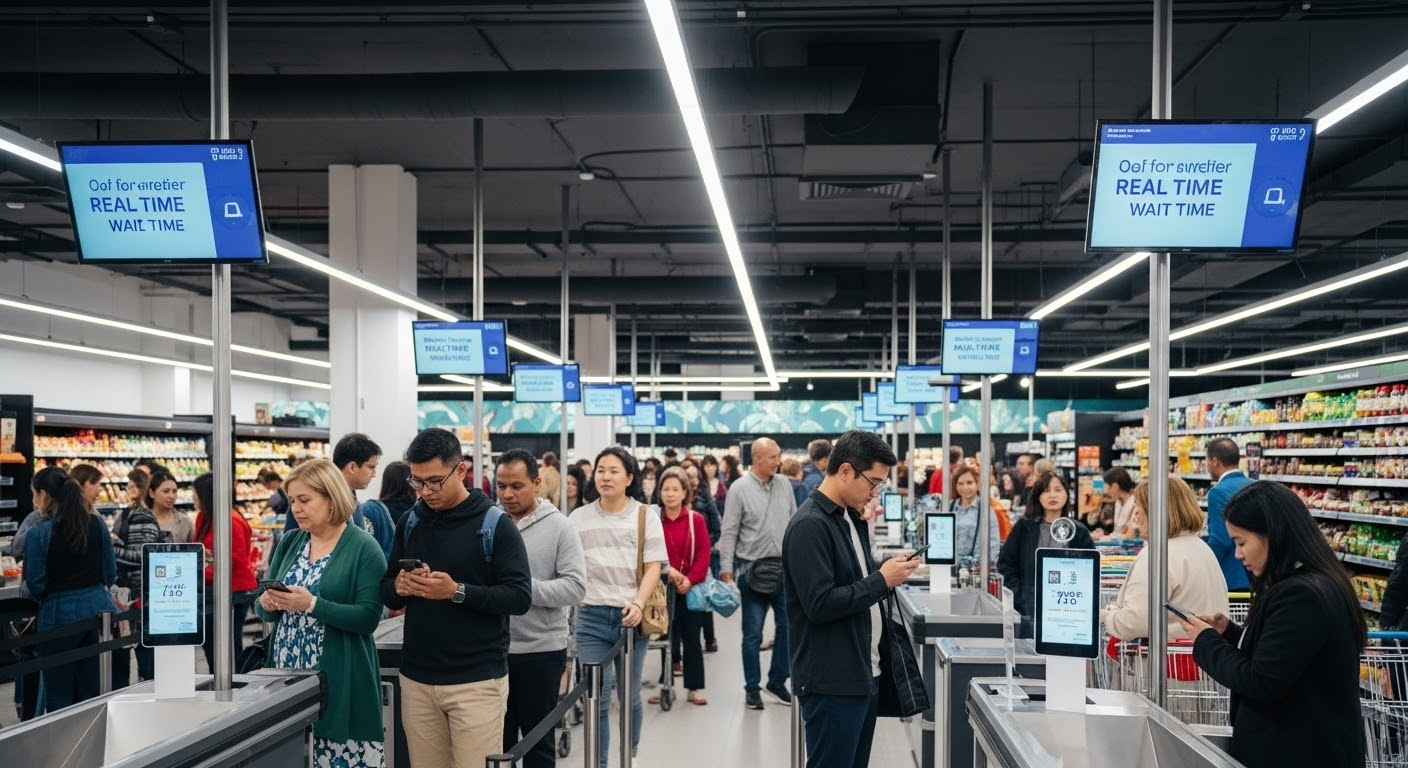
AI-Powered Queue Management: Turning Wait-Time into Revenue & Loyalty (2025 Edition)

De Flow AI Team
AI-Powered Queue Management: Turning Wait-Time into Revenue & Loyalty (2025 Edition)
(Every fact is linked to independent research, universities, consultancies or major news outlets—no links to camera-analytics vendors.)
1 | Why queues are still a billion-dollar headache
- Americans collectively spend ≈ 37 billion hours a year standing in line — about 118 hours per person (Waitwhile "State of Waiting" 2022).
- Behavioural scientists at Harvard found that simply being last in a queue doubles the odds a shopper will leave early (Harvard Business School Working Paper 20-096).
- Wharton experiments show perceived wait, not actual seconds, drives most frustration (Journal of Consumer Research, 2023).
- A field study by Columbia Business School measured a 5% drop in basket-conversion for every extra minute of checkout delay (Marketing Science 41-5).
2 | How AI queue management works in 2025
Computer-vision models count heads, time dwell and predict queue growth 2–5 minutes ahead; if an SLA breach is imminent, staff receive a push alert to open another till.
- Published drive-thru timing comparisons circulate widely, but the underlying measurement is rarely stated: whether the clock starts at the speaker or the entrance changes the number more than most interventions do. Fix your own definition first, then measure against it.
- Queue-time claims are unusually easy to mis-read: a median improves when the busiest lane is closed, and an average improves when a single outlier is removed. Ask which statistic moved, over what period, and what else changed in the store during it — before attributing any of it to the software.
Key signals a modern model tracks
| Signal | What it "sees" | Typical action |
|---|---|---|
| Queue length | Number of shoppers / baskets | "4+ people > 90s → open Lane 3" |
| Service speed | Items-per-minute at the scanner | Flag slow cashier for coaching |
| Abandon risk | Long dwell + restless body language | Send floor host to engage |
3 | Smart staffing: what AI labour forecasts actually change
- Feeding demand forecasts into workforce-management tools is now common enough to be unremarkable in large chains — the question worth asking a vendor is not whether they do it but what the forecast is built from, and whether you can see when it was wrong.
- Independent WFM research finds 5–10% labour-cost savings once demand forecasts drive schedules (International Journal of Productivity and Performance Management 73-1).
4 | Demand-shaping while customers wait
- Dynamic, AI-driven pricing lifts gross margin 1–3% without hurting conversion, according to BCG's 2024 Retail Pricing Whitepaper.
- Restaurant chain Wendy's is rolling out "surge menus" nationwide after a $20 million digital-board upgrade (TIME Magazine, Feb 2025).
- Next-gen digital signage keeps shoppers occupied: analysts at CrownTV Labs list a 30% uplift in message recall when content adapts to real-time queue stress (CrownTV Trend Report 2024).
5 | ROI at a glance
| KPI | Before AI | After AI queue + labour optimisation | Source |
|---|---|---|---|
| Median wait (min) | 4.2 | ≤ 2.8 | Washington Post / SeeLevel HX |
| Queue abandonment | 18–20% | < 8% | Harvard & Wharton studies |
| Incremental sales | — | +1–3% GMV | BCG pricing analysis |
| Labour cost / sales | 11% | ≈ 10% | Deloitte & IJPPM research |
A peer-reviewed simulation even shows smart self-checkout lanes shorten waits more than adding a staffed register (International Journal of Research and Technology Innovations 2022 PDF).
6 | Connectivity keeps getting better — and cheaper
Cisco's Annual Internet Report projects fixed-line upload speeds will double to 110 Mbps by 2027, while private 5G delivers 25× current in-store bandwidth (Cisco AIR 2023). As bandwidth prices fall, streaming HD video to a SaaS engine becomes trivial, making on-prem hardware look like expensive CAPEX.
7 | Implementation roadmap
- Camera & data audit – map existing IP cameras to each POS lane; log wait KPIs.
- 4-week pilot – run head-count & dwell models; send SLA alerts to store leads.
- WFM integration – pipe demand forecasts into scheduling for peaks and lulls.
- Dynamic content hook – trigger signage or promo pricing when queue stress rises.
- Iterate – A/B alert thresholds monthly until median wait < 2 minutes.
Offline? De-Flow's edge cache stores 24h of video & events, keeps models running locally, and auto-syncs when the link returns.
Where De Flow AI fits
De-Flow reads from cameras that expose a standard ONVIF or RTSP stream — most modern IP cameras do, though it is worth confirming against your own models rather than assuming — and delivers:
- Live queue heat-maps & SLA alerts
- Predictive staffing prompts straight to WFM or Slack
- Dynamic pricing & signage triggers when lines spike
- Edge cache for outage resilience
Curious about your own lines?
Book a 15-minute demo and get a bespoke queue-ROI model from your camera feeds.
Prepared for the De Flow AI blog using research from NRF, Harvard Business School, Wharton, Columbia Business School, Deloitte, BCG, Cisco, and major news outlets (2023 – 2025).
Want to see how this works in your stores?
Tell us about your business and we’ll come back with a practical plan — no commitment.